

Here's a scenario every hotel engineer knows: you're mid-shift on a busy Friday, occupancy is at 90%, and the HVAC in a block of rooms stops working. It didn't warn you. It didn't show up on any checklist. It just failed.
That's not bad luck. That's what happens when maintenance is reactive, or when preventive schedules aren't backed by real-time data. And in 2026, with operating costs climbing and guests less forgiving than ever, it's a pattern most hotels can't afford to keep repeating.
The fix isn't choosing between preventive and predictive maintenance. It's understanding how they're different, why you need both, and how the right hotel maintenance software makes running them together straightforward rather than a second job.
What Is Preventive Maintenance in Hotels? (And What It Gets Right)
Preventive maintenance (also called planned maintenance or scheduled maintenance) is a calendar-driven approach. You service equipment on a fixed schedule: monthly, quarterly, annually. The service happens whether or not the equipment is showing signs of wear.
Think: HVAC filters changed every three months. Boiler inspected every six months. Fire safety walks every week, on the dot.
The logic is sound. Regular servicing reduces the chance of equipment failing unexpectedly. Compared to purely reactive maintenance, where you fix things only after they break, it's a meaningful step forward.
Common preventive maintenance tasks in hotels include:
- Weekly kitchen equipment and refrigeration inspections
- Monthly HVAC filter replacements and air quality checks
- Quarterly pool and spa pump servicing
- Annual lift inspections and safety compliance checks
- Fire extinguisher checks and scheduled fire safety walks
The Limitation of Preventive Maintenance
Preventive maintenance has one well-known flaw: it treats every piece of equipment the same, regardless of how hard it's actually working.
A guest room air conditioning unit running 24/7 through a summer heatwave is not in the same condition as one in a rarely occupied room, even if both sit on the same quarterly service schedule. One gets serviced when it doesn't need it. The other degrades faster than the schedule anticipates.
That gap is exactly where predictive maintenance comes in.
What Is Predictive Maintenance in Hotels? (And Why It's Different)
Predictive maintenance is condition-based. Instead of following a fixed calendar, it monitors equipment in real time and flags potential failures before they happen, based on what the data is actually showing.
This works through IoT (Internet of Things) sensors installed on critical hotel assets: HVAC units, boilers, lifts, commercial kitchen equipment, laundry machines. Sensors track variables like temperature, vibration, pressure, energy consumption, and runtime continuously.
AI analyses that data against historical patterns and identifies deviations that signal a developing problem. When a threshold is crossed, a maintenance task is automatically created and routed to the right person. No manual monitoring. No issue missed because someone was off shift.
As Snapfix explains in their predictive maintenance guide for hotels, the practical difference is stark:
A preventive maintenance programme tells you to service HVAC units in March. A predictive programme tells you the unit in Room 312 is showing early signs of compressor stress and should be looked at this week, before peak occupancy in May.
One of those conversations happens on your terms. The other happens at the worst possible time.
Preventive vs. Predictive Maintenance: Side-by-Side Comparison
|
Preventive Maintenance |
Predictive Maintenance |
|
|
Trigger |
Calendar schedule |
Real-time equipment condition |
|
Data used |
Manufacturer guidelines, historical averages |
IoT sensors, AI analysis, live performance data |
|
Main benefit |
Reduces unexpected failures |
Eliminates unnecessary servicing, catches early faults |
|
Best for |
Safety checks, compliance, routine upkeep |
Critical assets with high failure cost |
|
Cost |
Predictable, manageable |
Higher setup; significant long-term savings |
|
Hotel example |
Quarterly HVAC filter change |
Alert: boiler pressure trending abnormal, inspect now |
Neither replaces the other. The most effective hotel maintenance programmes use both, with preventive as the baseline and predictive as the intelligence layer on top.
Reactive vs. Preventive vs. Predictive Maintenance: Which Stage Is Your Hotel At?
Most hotel maintenance programmes mature through three stages:
- Stage 1: Reactive maintenance. Fix it when it breaks. High emergency costs, frequent guest disruption, team constantly firefighting. Most common in smaller independent properties without a structured programme.
- Stage 2: Preventive (planned) maintenance. Scheduled servicing, recurring checklists, compliance tracking. A significant improvement, but still calendar-driven rather than condition-driven.
- Stage 3: Predictive maintenance. Real-time condition monitoring, AI-generated alerts, work orders created automatically when data flags a developing fault. The operation runs ahead of problems, not behind them.
Most independent and boutique hotels sit somewhere between Stage 1 and Stage 2. The technology to reach Stage 3 has historically been expensive and complex. That's changing fast.
How Snapfix Supports Preventive and Predictive Maintenance in One Platform
Snapfix is purpose-built for hotel and facilities teams. It's not industrial CMMS software retrofitted for hospitality. Every feature is designed for how hotel maintenance actually works: lean teams, 24/7 operations, guest-facing consequences, and zero tolerance for things slipping through the cracks.
Here's how it covers both maintenance approaches:
Planned Preventive Maintenance: Snapfix Plan
Snapfix Plan handles your scheduled maintenance programme from end to end:
- Schedule recurring tasks across daily, weekly, monthly, or annual cycles, assigned to the right team member
- Custom checklists with photos, voice notes, NFC tag scans, and digital signatures built in as standard
- Automatic reminders so the platform notifies your team when a task is due with no manual chasing needed
- Complete audit trail with every completed task logged by timestamp, assignee, and photographic evidence
- Compliance-ready documentation covering fire safety walks, health and sanitation audits, and brand standard inspections all in one place
"Don't let 'I forgot' be the reason for a failed audit." That's the standard Snapfix Plan is built around.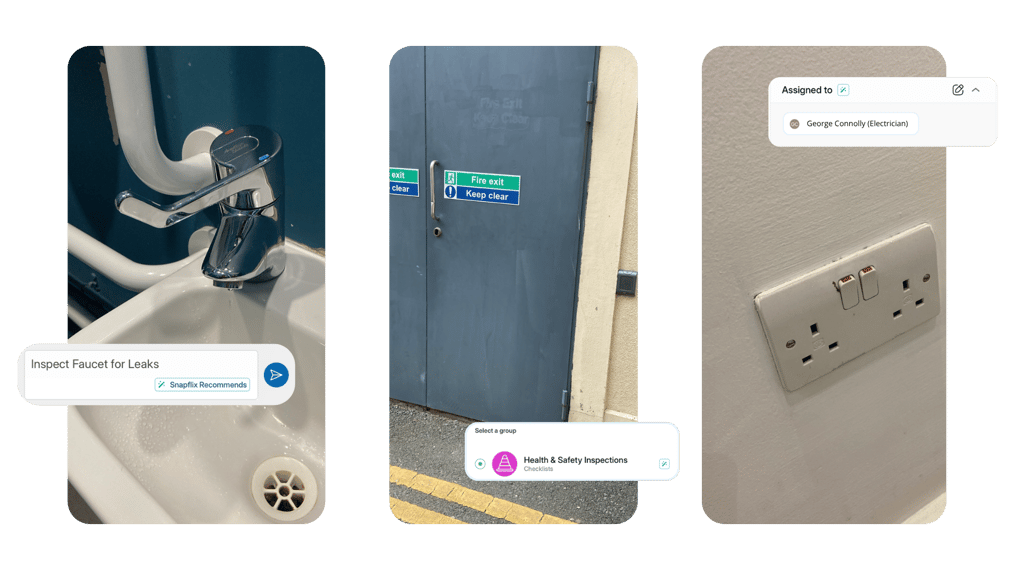
Predictive Maintenance: IoT Integration and AI-Triggered Work Orders
Snapfix's IoT integration connects your sensor data directly to the platform:
- Continuous asset monitoring across HVAC, boilers, lifts, kitchen equipment, and laundry machines
- AI-powered deviation detection picking up temperature spikes, abnormal vibration, and pressure drops before they escalate
- Automatic work order creation the moment a threshold is crossed, routed instantly to the right engineer
- Around-the-clock coverage so faults are caught outside working hours and during shift changes, not after the fact
AI-Powered Housekeeping: Snapfix Housekeeping
The Snapfix AI Housekeeping module brings the same operational intelligence to room turns:
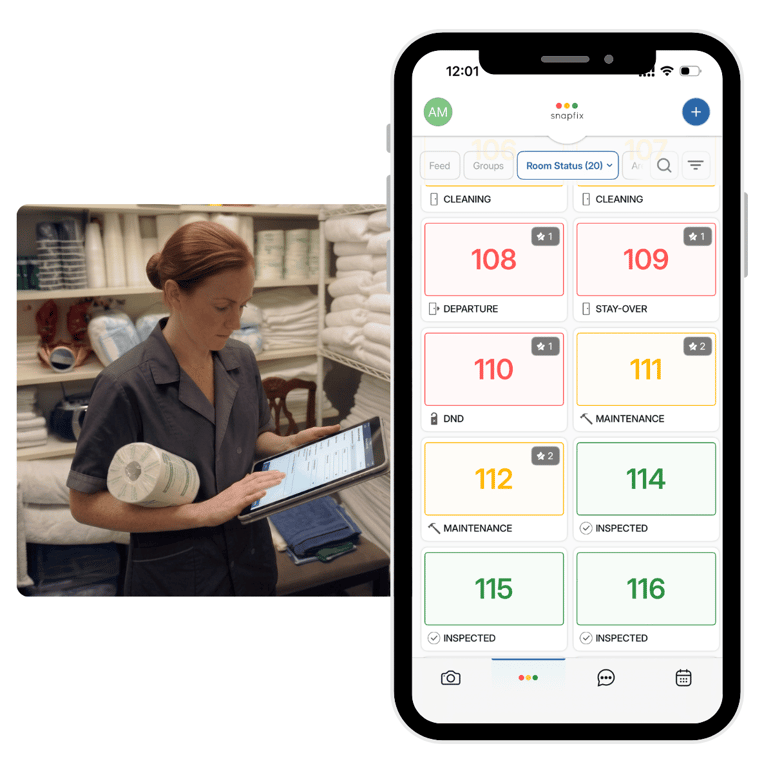
- AI-generated room schedules that sync with your PMS and optimise assignments the moment you open the app
- Live room status so inspectors can see DND rooms, late check-outs, and priority turnarounds at a glance
- Cross-department visibility giving maintenance, housekeeping, and front desk one shared live view
- Measurable results including rooms available up to two hours earlier, labour costs reduced by up to 25%, and manual morning planning cut from 90 minutes to seconds
Asset Management and Operational Analytics
- Snapfix Track keeps a full history of every asset including purchase dates, warranty info, and repair history, so repair-or-replace decisions are based on data rather than guesswork
- Snapfix Data Analytics surfaces which rooms generate the most issues, which assets are trending toward failure, and where your team's time is actually going
Which Hotel Maintenance Strategy Should You Prioritise?
The honest answer: you need both, implemented in the right order.
If you don't have a structured programme yet, start with preventive maintenance. Get recurring tasks scheduled, checklists built, and compliance documentation digital and automated. That's your foundation.
Once the basics are solid, layer in predictive maintenance on your highest-value, highest-risk assets: HVAC systems, boilers, lifts, and commercial kitchen equipment. These are the assets where an unplanned failure causes the most disruption and the most cost.
When both are running, your maintenance team shifts from firefighting to managing. And your guests stop noticing maintenance at all, which is exactly how it should be.
See How Snapfix Manages Both
If your team is still catching problems after guests do, it is time to change that. Snapfix brings predictive maintenance, AI-powered operations, and guest communications into one platform built for hotel teams.
Book your free demo or start a free trial and see exactly how it works for your property type, your team size, and your biggest operational headaches.
Frequently Asked Questions: Preventive vs. Predictive Hotel Maintenance
1. What is the main difference between preventive and predictive maintenance in hotels?
Preventive maintenance follows a fixed schedule where you service equipment at set intervals regardless of its condition. Predictive maintenance is condition-based: IoT sensors and AI monitor equipment in real time and flag developing faults before they cause a breakdown. Preventive maintenance is your baseline; predictive is the intelligence layer that catches what the schedule misses. Snapfix supports both.
2. Is predictive maintenance worth it for small or independent hotels?
Yes, especially now that the technology is far more accessible than it was five years ago. The core value of predictive maintenance is preventing emergency repairs that cost four to five times more than planned work. For a smaller property with a lean maintenance team, catching a boiler fault early can be the difference between a manageable repair and a full operational crisis mid-peak. Snapfix is designed for hotels of all sizes.
3. What hotel equipment should be prioritised for predictive maintenance?
Start with your highest-cost, highest-risk assets: HVAC systems, boilers, commercial kitchen equipment, lifts, and pool and spa pumps. These are the assets where failure causes the most guest-facing disruption and the largest emergency repair costs. Snapfix Track helps you build a full asset register and repair history before deciding where to deploy sensors first.
4. How does hotel maintenance software support both preventive and predictive maintenance?
Good hotel maintenance software like Snapfix handles scheduled preventive tasks through recurring checklists, automatic reminders, and digital audit trails, and integrates with IoT sensors to generate predictive alerts automatically. When a sensor reading flags a developing fault, a work order is created and routed to the right engineer without any manual intervention. Both approaches run through a single platform.
5. What's the difference between reactive, preventive, and predictive maintenance for hotels?
Reactive maintenance fixes problems after they occur and carries the highest costs and most guest disruption. Preventive maintenance schedules servicing in advance to reduce failures, which is better, but still calendar-driven. Predictive maintenance uses real-time data to catch faults before they become failures and is the most cost-effective and least disruptive approach. Most hotel maintenance programmes mature from reactive to preventive to predictive over time. Learn how Snapfix supports each stage.
6. How does AI improve hotel maintenance and housekeeping operations?
AI in hotel operations automates decisions that previously required manual effort or experience. In maintenance, AI analyses sensor data to detect equipment faults early and automatically raises work orders. In housekeeping, Snapfix AI Housekeeping generates an optimised room assignment schedule in seconds by syncing with your PMS, replacing up to 90 minutes of manual morning planning. The result across both departments is fewer failures, faster room turns, and lower costs.