

There is a version of hotel maintenance that most teams know well. Something breaks. Someone reports it. A work order gets raised. A repair gets done. And somewhere in the middle of that sequence, a guest notices.
That cycle is not just inefficient.
In 2026, with operating costs climbing and guest expectations higher than ever, it is becoming genuinely expensive. According to research published by McKinsey, unplanned downtime in hospitality can cost tens of thousands of dollars per hour when you factor in emergency repair fees, lost room revenue, and guest compensation. That is the true cost of reactive maintenance, and it is one most hotel operators do not see until it is already too late.
Predictive maintenance is changing that. And with AI now built directly into the tools hotel teams use every day, the shift from reactive to proactive has never been more within reach.
What Is Predictive Maintenance?
Predictive maintenance is an approach that uses data, sensors, and software to monitor equipment condition in real time and flag potential failures before they actually happen. Rather than waiting for something to break down, or following a fixed calendar-based schedule regardless of actual equipment condition, predictive maintenance works by reading the signals that equipment sends out as it begins to degrade.
That might be an unusual vibration pattern in an HVAC unit. A subtle change in energy drawn from a pump. A temperature reading that is slightly out of range on a refrigeration system. On their own, these signals are easy to miss. Processed by AI, they become early warnings that allow a maintenance engineer to intervene before a guest ever notices a problem.
The idea is not new, but it is arriving in hospitality at exactly the right moment. Hotels operate around the clock, often with lean maintenance teams and no margin for unplanned disruption. Predictive maintenance gives those teams something they have rarely had before: time.
How Does Predictive Maintenance Work?
At its core, predictive maintenance relies on three things working together: data collection, analysis, and action.
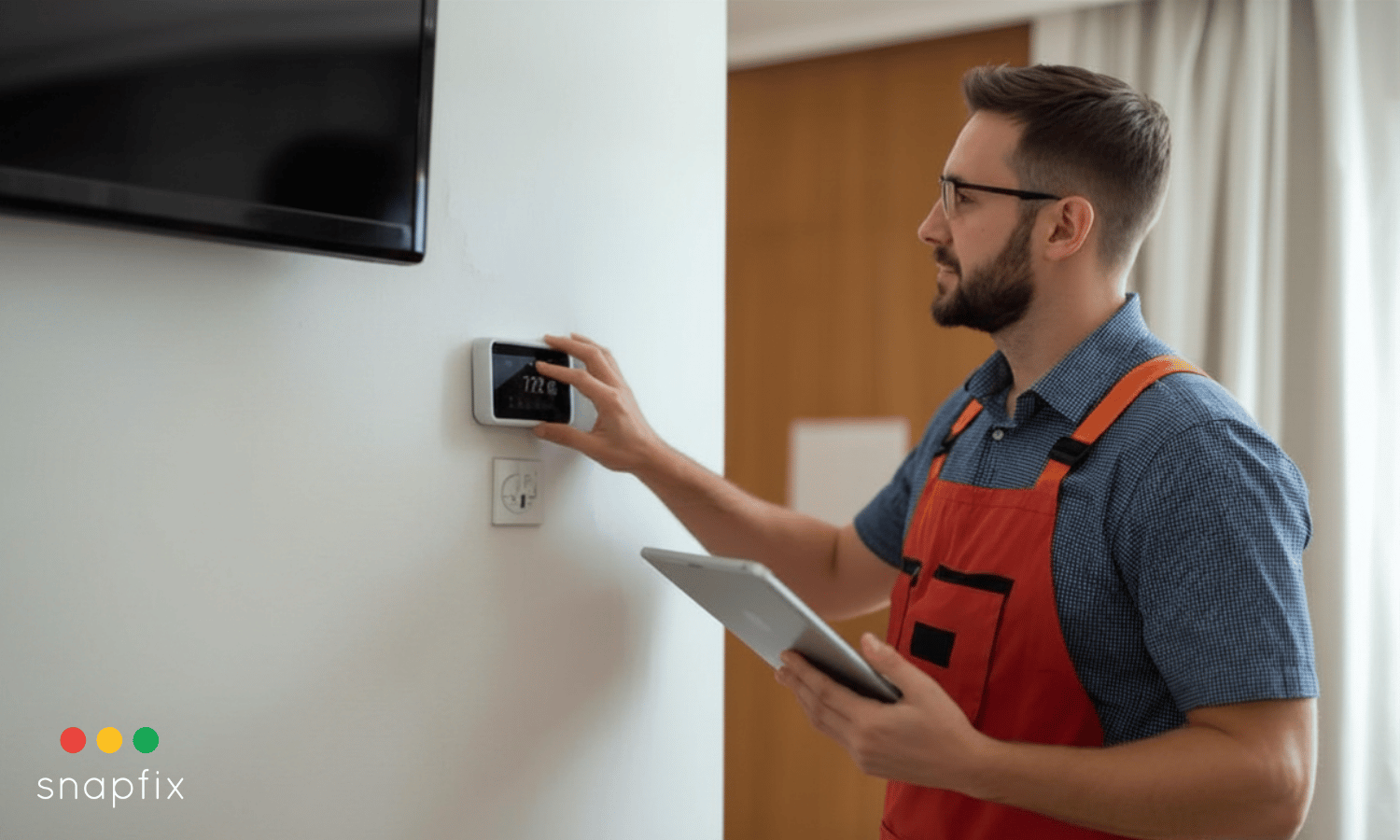
Data collection: typically happens through IoT (Internet of Things) sensors installed on critical equipment across the property. These sensors continuously monitor variables like temperature, vibration, pressure, energy consumption, and runtime. In a hotel, that might mean sensors on boilers, HVAC systems, lifts, kitchen equipment, or laundry machines.
Analysis: is where AI comes in. Machine learning models process the incoming data streams, compare them against historical patterns, and identify deviations that indicate developing problems. Research from Deloitte has found that predictive maintenance can reduce equipment downtime by 30-50% and extend asset life by 20-40%. The system does not just detect that something is wrong; it can estimate how long a piece of equipment has before it is likely to fail, giving maintenance teams the ability to plan repairs at a time that works for the property.
Action: is what closes the loop. When the system identifies a problem, it automatically creates a maintenance task and routes it to the right person. No manual monitoring required. No issue slipping through the cracks because someone was busy or off shift.
That sequence, from sensor signal to resolved work order, is what separates predictive maintenance from everything that came before it.
Preventive vs Predictive Maintenance: Understanding the Difference
These two terms are often used interchangeably, but they describe fundamentally different approaches to maintenance management.
Preventive maintenance operates on a fixed schedule. An HVAC unit gets serviced every three months. A boiler gets inspected annually. The timing is based on manufacturer recommendations or historical averages, not on what is actually happening with the equipment. This is a significant improvement over purely reactive maintenance, but it has a well-documented weakness: it treats all equipment the same, regardless of how much it has actually been used or how it is performing. That means some equipment gets serviced unnecessarily, while other equipment that is running hard degrades faster than the schedule anticipates.
Predictive maintenance is condition-based. Maintenance happens when the data says it is needed, not when the calendar says so. According to the Uptime Institute, emergency repairs can cost up to five times more than planned maintenance. Predictive maintenance reduces the frequency of those emergency situations by catching developing problems early, at a point where a small, inexpensive intervention prevents a large, disruptive failure.
For hotels, the practical difference is significant. A preventive maintenance programme will tell you to service your HVAC units in March. A predictive maintenance programme will tell you that the unit in Room 312 is showing early signs of compressor stress and should be looked at this week, before peak occupancy in May.
One of those conversations happens on your terms. The other happens at the worst possible time.
The Real Benefits of Predictive Maintenance for Hotels
The benefits of predictive maintenance are well-documented across industries, but in hospitality they carry an additional dimension: the guest experience.
Lower maintenance costs. Studies from the National Center for Manufacturing Sciences indicate that predictive approaches can extend equipment life by 25-50% compared to run-to-failure approaches. Scheduled repairs are cheaper than emergency ones. Parts replaced early cost less than systems that fail completely.
Reduced disruption. When repairs are planned in advance, they can be scheduled during low-occupancy periods, not in the middle of a busy weekend. That means fewer room closures, fewer complaints, and fewer situations where the front desk team is managing a guest whose room is unavailable.
Energy efficiency. Equipment that is beginning to fail typically draws more energy as it compensates for degraded performance. ENERGY STAR estimates that properly monitored and maintained HVAC systems alone can reduce energy consumption by 35-45% in hotel guest rooms. In a 200-room property where HVAC can account for nearly half of total energy use, that is a meaningful number.
Better team focus. When maintenance teams are not constantly firefighting breakdowns, they have the capacity to focus on planned, organised work. That is better for morale, better for efficiency, and better for the property overall.
Stronger guest satisfaction. Ultimately, the best maintenance is the kind guests never experience at all. A room where everything works, the temperature is right, and nothing interrupts a stay is the baseline guests expect. Predictive maintenance is one of the most direct ways to deliver it consistently.
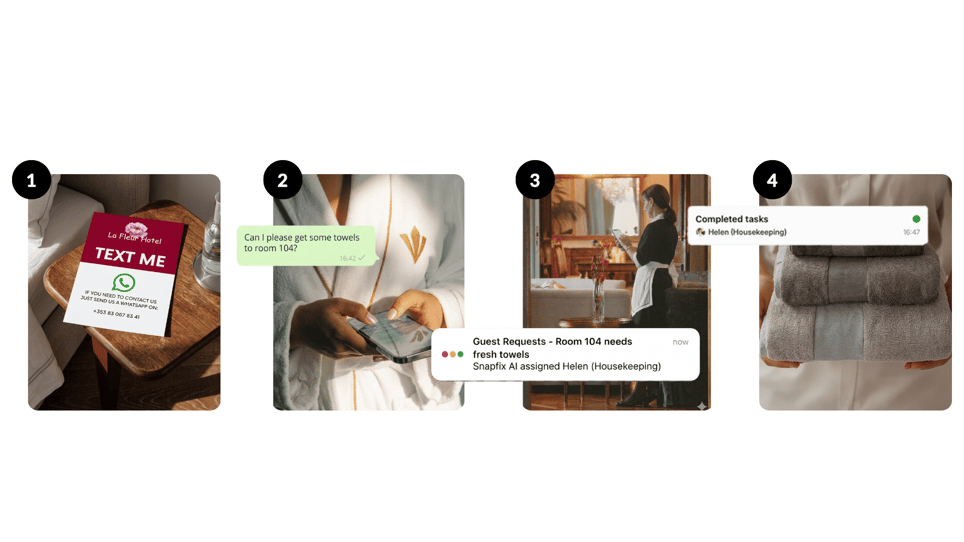
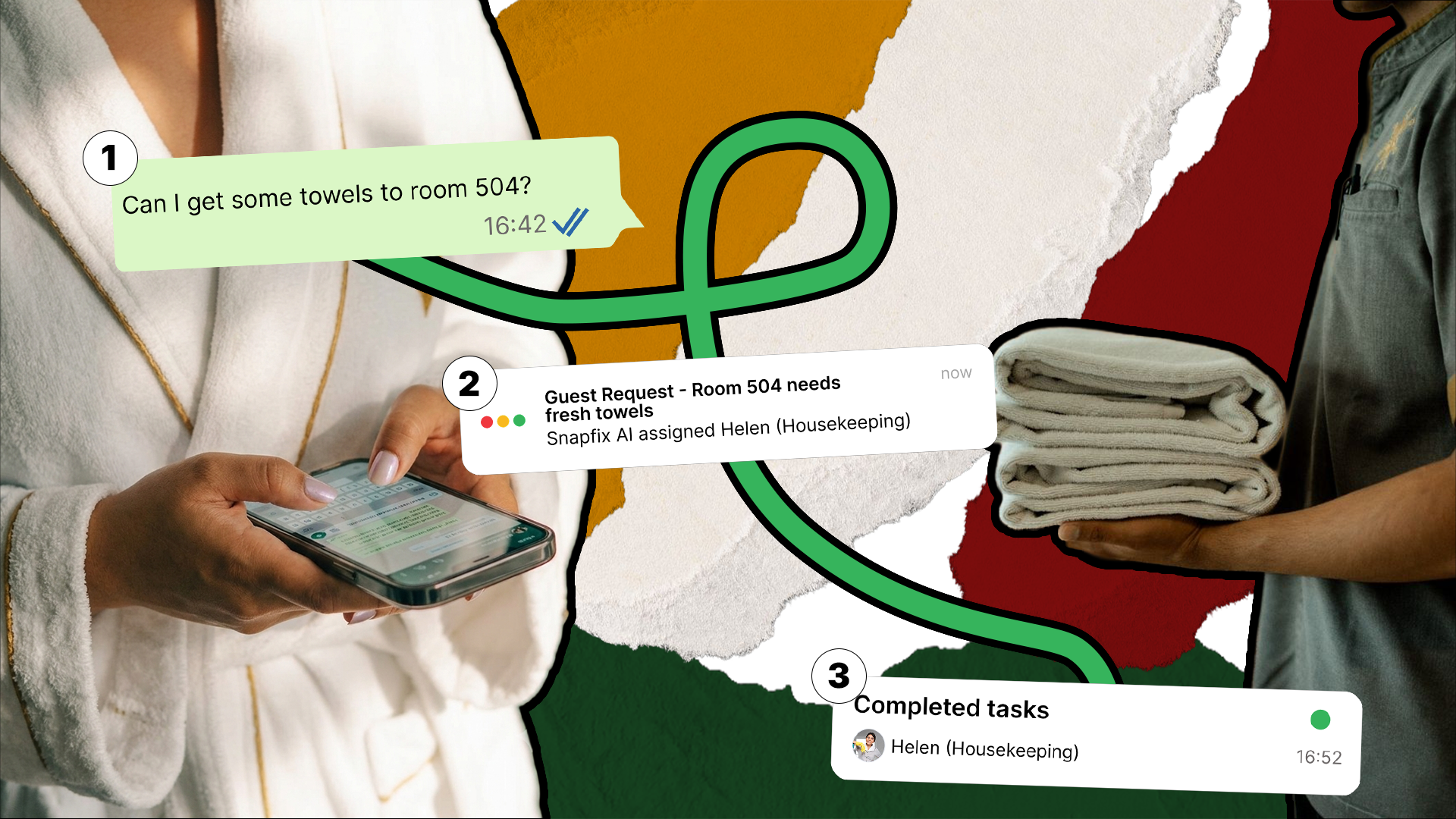
Snapfix goes a step further. Snapfix Guest Comms automatically converts incoming guest messages into operational tasks routed directly to the right team, so even the moments that do require a response are handled quickly, without anything getting lost in the handoff. It is the difference between a hotel that reacts well and one that barely needs to react at all.
Where Predictive Maintenance Software Fits Into Hotel Operations
Understanding the approach is one thing. Implementing it is another. The gap between the two is where the right predictive maintenance software makes a real difference.
For hotel teams, the practical challenge is not conceptual; it is operational. Maintenance engineers are busy. Work orders pile up. Equipment registers are often outdated or stored in spreadsheets. And when something goes wrong, everything else gets deprioritised to deal with the emergency.
Effective predictive maintenance solutions need to work within those realities, not require teams to build entirely new workflows from scratch. The best predictive maintenance software connects asset tracking, scheduled inspections, IoT data, and work order management into a single platform that teams can actually use on the ground, not just in a boardroom presentation.
How Snapfix Is Building Predictive Maintenance Into Hotel Operations
At Snapfix, the focus has always been on building software for the people who actually keep hotels running. Maintenance engineers. Housekeepers. Floor supervisors. The people who need tools that work in the corridor, not just in a system demo.
That same thinking guides how Snapfix is approaching AI and predictive maintenance.
IoT Integrations
Snapfix's IoT integrations allow connected systems across a property to feed signals directly into the platform. When a sensor detects a developing issue, Snapfix automatically creates a maintenance task and routes it to the right person. What would previously have surfaced as a guest complaint, or a full breakdown at the worst possible moment, instead becomes a proactive fix that happens before checkout.
AI Task Creation
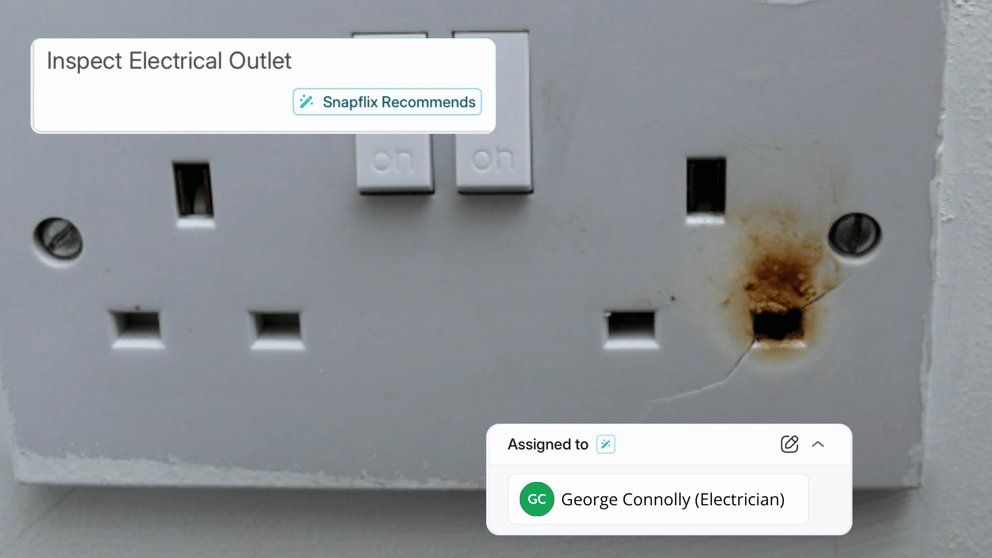
The AI task creation feature extends this thinking further. When a team member photographs an issue, whether a damaged fitting, a piece of equipment behaving unusually, or a fault spotted during an inspection, the AI identifies what is in the image, titles the task, categorises it correctly, and assigns it to the right department.
The engineer receives a notification with the photo, the room number, and everything needed to act immediately. No manual data entry. No translation barriers for multilingual teams. No delay between spotting a problem and starting to solve it.
Planned Maintenance
Snapfix's planned maintenance tools allow scheduled inspections and recurring tasks to be set up in advance, ensuring that preventive checks run consistently without relying on individual memory or paper-based systems. And the asset management module keeps a complete history of every work order against every piece of equipment, building the kind of operational data that makes predictive analysis more accurate over time.
AI Checklist Library
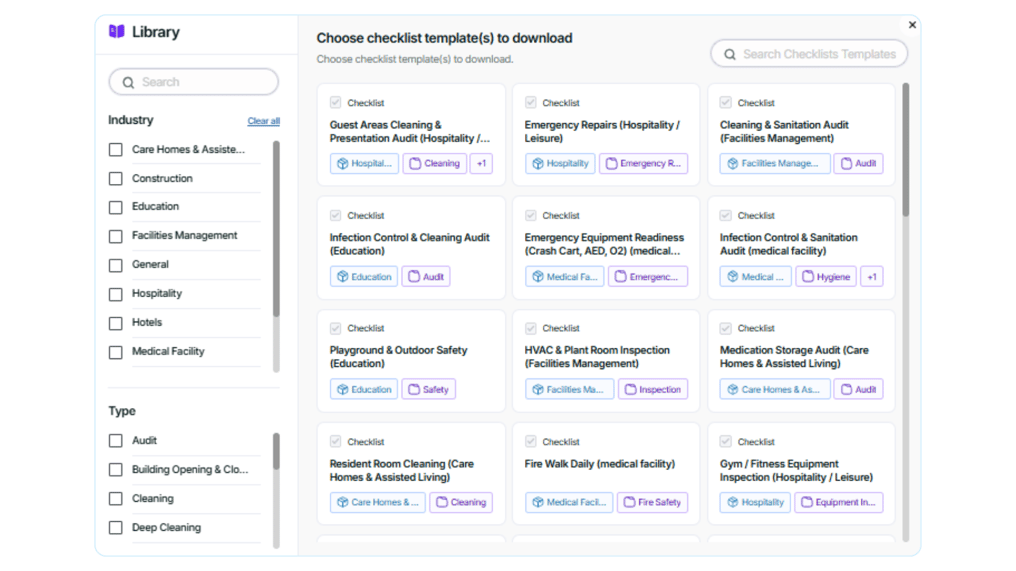
The AI-generated checklist library, trained on data from thousands of hotel teams, brings consistency to inspections across different experience levels and shift patterns. And when guest communications arrive via WhatsApp, Snapfix automatically converts those messages into operational tasks, so nothing gets lost between a guest request and a team response.
Taken together, these features represent a practical shift from reactive maintenance to something more intelligent: an operation where issues are spotted early, tasks are organised efficiently, and the guest experience is protected by systems working quietly in the background.
What Hotels Need to Know Before Getting Started
A few honest observations for teams considering the move toward predictive maintenance solutions.
Start with your highest-risk assets. HVAC systems, boilers, lifts, and kitchen equipment cause the most disruption when they fail. Sensors and monitoring on these systems deliver the most immediate return.
Data quality matters. Predictive maintenance is only as good as the data feeding it. Keeping your asset register current and ensuring sensors are installed correctly is the foundation everything else builds on.
Integration is everything. Predictive maintenance data is most valuable when it connects directly to your work order system. A sensor alert that generates an email nobody reads is not predictive maintenance in practice; it is just more noise. The signal needs to become a task automatically.
The shift from reactive to proactive takes time. Teams that have spent years firefighting breakdowns do not change overnight. The right software reduces the friction of that transition, but it still requires clear processes, consistent use, and leadership that reinforces the new approach.
The Direction of Travel
PwC's 2026 hospitality analysis identifies AI-enabled predictive maintenance as one of the key shifts underway in hotel operations, noting the movement from emergency repair models toward proactive systems that reduce downtime and extend asset lifespan. That shift is happening across the industry, and the gap between properties that have made it and those that have not is already visible in operating costs, guest satisfaction scores, and team efficiency.
The good news is that making the move does not require a complete technology overhaul. It requires the right platform, a clear starting point, and a team that knows what it is trying to achieve.
If you want to see how Snapfix brings predictive maintenance and AI-powered operations together in practice, book a demo and we will walk you through exactly how it works for hotels like yours.

.png)