


For years, the gap between hotel maintenance and housekeeping has been one of the most persistent operational challenges in the industry. A housekeeper spots a broken fixture, radios it in, and hopes it gets picked up. A maintenance technician completes a repair without looping in housekeeping. A guest checks into a room that was never cleared for occupancy.
The failure is not a people problem. It is a systems problem – and its consequences are real. Guests notice when rooms aren't properly maintained, and the impact on reviews and revenue follows. With labour costs rising and teams stretched thin, the margin for error has never been smaller.
The traditional model built on radio calls, paper checklists, and disconnected apps was not designed for this environment. In 2026, AI is finally providing the infrastructure that connects hotel maintenance and housekeeping into one intelligent, responsive operation.
How AI Is Transforming Hotel Maintenance and Housekeeping Operations in 2026
The most meaningful shift in AI for hotels is not happening at the front desk. It is happening in the operational layer between maintenance, housekeeping, and management, where the smallest coordination failures have the biggest impact on the guest experience.
Here is where it is making a real difference.
AI-Powered Housekeeping Management and Room Scheduling
Traditional hotel housekeeping scheduling is rigid. Rooms are assigned at the start of a shift, and the plan rarely adapts to what is actually happening on the floor, whether that is a late check-out, a maintenance hold, a VIP early arrival, or a room that needs a deeper clean after an extended stay.
AI-powered hotel housekeeping software makes scheduling dynamic and responsive. Instead of a static list, AI analyses real-time occupancy data, check-out patterns, room priority flags, and staff availability to automatically assign and sequence cleaning tasks in the most efficient order. The result is a housekeeping team that always knows what to do next, without waiting for a manager to redistribute work manually.
According to a 2026 BCG report, AI applications in hotel housekeeping can reduce room turnover times by up to 20%, translating directly into faster turnovers, more efficient use of staff hours, and fewer delays at check-in. For a busy hotel running at high occupancy, that is a significant operational gain.
AI-Enabled Predictive Maintenance for Hotels
Reactive hotel maintenance is one of the most expensive operational habits a property can have. Emergency repairs cost more, take longer to resolve, and often result in rooms going out of service at the worst possible moment.
Predictive maintenance technology uses real-time data and machine learning to identify equipment issues before they become failures. For hotel assets like HVAC systems, boilers, lifts, and pool plant equipment, this means scheduled interventions instead of emergency call-outs. The measurable outcomes include:
- Up to 30% reduction in equipment downtime
- Lower emergency repair costs by catching issues at the earliest stage
- Longer asset lifespans through consistent, data-driven servicing
- Fewer out-of-service rooms during peak periods, protecting RevPAR
For hotel engineering and facilities teams managing hundreds of assets across multiple floors and building systems, the shift from reactive to predictive hotel maintenance is one of the highest-impact changes AI enables.
AI Task Creation: From Report to Work Order in Seconds
One of the most time-consuming parts of hotel maintenance management has always been the manual creation of work orders. A team member identifies an issue, messages a supervisor, the supervisor logs it, assigns it, and significant time has already passed.
AI task creation removes that lag entirely. When an issue is reported, whether through a photo, a voice note, or a guest-facing channel, AI automatically generates a structured work order with the relevant details, suggested priority level, and assignment to the right team member, all without manual input.
The reporting process itself is often where momentum dies – a spotted issue becomes a manually logged task, and somewhere in that handoff, urgency is lost.
Snapfix's AI Task Creation feature eliminates that gap, analysing a reported issue and generating a fully formed task in seconds, so nothing sits in a queue waiting to be documented.
AI-Optimised Checklist Library for Hotel Inspections and Compliance
Checklists are central to how hotels maintain standards across housekeeping, preventive maintenance, fire safety, and compliance. But building and managing them manually is slow, inconsistent, and prone to gaps, particularly when procedures change or new staff join the team.
AI analyses your workflows and suggests structured, best-practice checklists tailored to the specific task type, whether that is a room servicing check, a preventive maintenance inspection, a fire safety walkthrough, or an end-of-season deep clean.
For hotel operations teams, this means:
- Faster checklist creation without starting from scratch every time
- Consistent standards applied across every shift, every team member, and every location
- Structured digital records that support compliance and audit trails
- Checklists that evolve with your operations rather than becoming outdated
For hotel groups operating across multiple properties, AI-optimised checklists mean that best practices from one site can be instantly rolled out across the portfolio through Snapfix Multi-Site.
AI-Powered Guest Communications
Guest expectations around response times have shifted significantly. Guests want fast, accurate answers to service requests, and they want them at any hour. Meeting that expectation with human staff alone puts real pressure on front-desk and operations teams.
AI-powered guest communications within Snapfix Chat help hotels respond to guest requests faster and more consistently. When a guest raises a request, AI can automatically route it to the right department, suggest a response, and create a task if action is needed, all within a single platform. This closes the loop between what guests ask for and what hotel operations teams actually deliver, reducing the gap that so often results in negative reviews.
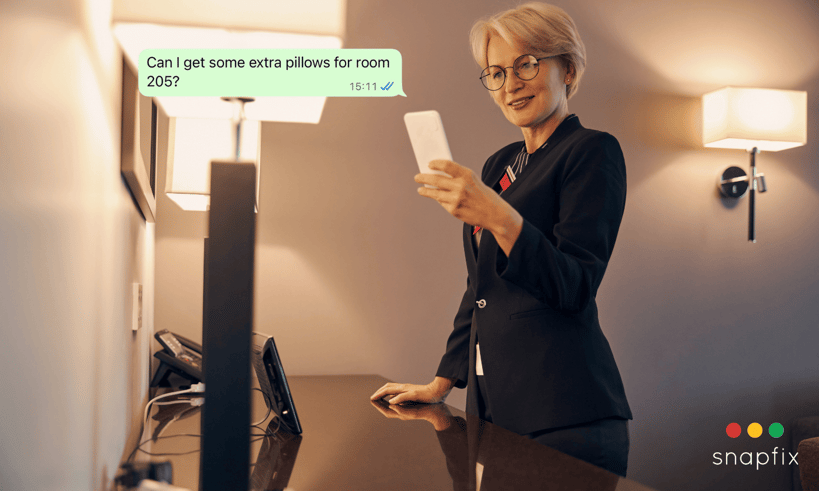
73% of hotel operators report that AI helps reduce costs associated with guest services, and hotels using AI-powered communication tools are seeing measurable improvements in both response times and guest satisfaction scores.
Why 2026 Is the Year to Get AI in Hospitality Right
According to the 2026 Hospitality Industry Outlook, this year is the inflection point. Hotels that build the foundations for AI now will pull ahead. Those that wait risk falling behind competitors already compressing operational costs and delivering better guest experiences through smarter hotel operations technology.
The numbers reflect the urgency:
- 52% of hotel management companies are actively investing in AI to improve operational efficiency
- 88% of hotel operators believe AI will be essential to future hotel operations
- AI-driven hotel scheduling tools are reducing labour costs by an average of 12%
- AI-enabled predictive maintenance is cutting hotel equipment downtime by up to 30%
The barrier to entry is lower than many hoteliers expect. Implementing AI-powered hotel maintenance software does not require a major IT overhaul. It requires the right platform, one built for the way hotel teams actually work.
How Snapfix Brings AI to Hotel Maintenance and Housekeeping
Snapfix is a visual-first hotel operations and maintenance platform built specifically for the hospitality industry, now with AI built into the features your teams use every day.
- AI Task Creation automatically generates structured work orders from reported issues, cutting the time between spotting a problem and getting it actioned
- AI-Optimised Checklist Library helps teams build and deploy consistent hotel inspection and servicing checklists, with best-practice structure built in
- AI-Powered Guest Communications via Snapfix Chat routes guest requests to the right team instantly, with AI-suggested responses and automatic task creation
- Snapfix Rooms gives housekeeping, maintenance, and front desk a live, colour-coded view of every room's status, with PMS integration and priority flags for VIPs and urgent requests
- Planned Preventive Maintenance keeps your engineering team ahead of failures with scheduled, recurring tasks tied to your hotel asset register
- Data Analytics surfaces patterns behind recurring issues, team performance, and maintenance trends so hotel managers can make smarter operational decisions
The Morrison Hotel, a Snapfix customer, reported saving 1.5 hours per day across their engineering and accommodation management teams, time previously spent on paperwork and manual task tracking.
Ready to See What AI-Powered Hotel Operations Looks Like?
Hotel teams should not have to rely on radio calls, WhatsApp messages, or manual room updates to keep operations moving. With the new housekeeping module from Snapfix, your housekeeping, maintenance, and front desk teams can now work from one live operational system built for faster room turnaround and better coordination.
See real-time room status updates, instant task assignment, live issue reporting, and AI-powered workflows designed specifically for hotel operations.
Explore the new housekeeping module here:
Snapfix Housekeeping
Or Book a free 30-minute demo to see how leading hotels are reducing delays, improving communication, and keeping rooms guest-ready faster.
Prefer to explore first? Start a free trial and get your team up and running with no lengthy onboarding and no complicated setup.