

There is a scene that plays out across hotel properties every single day. A maintenance engineer finishes one job, walks back to find out what is next, and spends twenty minutes figuring out who reported what, from which room, and whether anyone else has already dealt with it.
A housekeeper spots a faulty light fitting, tells a colleague, who tells the supervisor, who scribbles it on a notepad that never reaches the right person. A guest calls the front desk about a broken shower head. The front desk calls housekeeping. Housekeeping says it is a maintenance issue. Maintenance is unreachable.
The problem does not get fixed faster because there are fewer people. It gets fixed slower. And the team, already stretched, spends a disproportionate amount of time not on the work itself but on the coordination around it.
This is the hidden cost of being short-staffed in hotel operations. Not just the tasks that go undone, but all the time lost chasing the ones that should.
The Staffing Reality Hotels Are Still Living With
The numbers have not shifted as much as the industry would like. According to the American Hotel and Lodging Association, a clear majority of hotels still report active staffing shortages, carrying an average of six to seven unfilled roles at any given time. The pressure falls hardest on:
- Housekeeping – the most consistently understaffed department
- Front desk – where interdepartmental communication is routed
- Maintenance – where delays compound directly into guest-facing failures
Hotel employment remains close to 10% below pre-pandemic levels, and the industry's quit rate continues to outpace almost every other sector. Hotels are not just dealing with a shortage. They are dealing with a churn that makes building any stable operational rhythm genuinely difficult. The problem is not going away by hiring alone.
Why Understaffed Hotel Maintenance Teams End Up Chasing Instead of Fixing
The assumption is that a smaller team simply does less. What actually happens is that smaller teams spend a higher proportion of their time on coordination rather than execution. The ratio of admin to action tips badly in the wrong direction.
Here is why:
- Communication does not scale down with headcount. When a team is fully staffed, information moves through dedicated channels. Strip those roles and the remaining members absorb the communication work on top of their actual jobs. The engineer chases updates. The housekeeper figures out who to tell about a fault because the usual contact is not available.
- Reactive work crowds out planned work. One hour of planned maintenance prevents roughly three hours of reactive repair. But planned maintenance requires headspace and scheduling capacity that short-staffed teams simply cannot access. The planned work gets pushed. Issues accumulate. The next shift inherits a heavier load than the last.
- Manual systems amplify every gap. A printed room board, a WhatsApp group, a sticky note on the supervisor's desk. These work well when the team is complete. When you are short-staffed with newer employees still finding their footing, every manual step is a potential failure point. A message not sent. A note lost. A room unchecked because nobody knew it was their job.
- The cost lands on the guest. Guests do not experience the operational friction directly. They experience its consequences. A room not ready at check-in. A fault unreported across two shifts. A request buried in a group chat. The review gets written based on what the guest experienced, not on how hard the team tried.
The Coordination Tax: What It Actually Costs
Track a maintenance engineer's day in a short-staffed hotel, and much of it will not involve fixing anything. It will involve:
- Finding out what needs repairing and from which room
- Confirming whether someone else has already started the job
- Clarifying what the problem actually is from a vague description
- Chasing confirmations across radio, chat, and in-person conversations
- Updating whoever is waiting to hear it has been resolved
This is the coordination tax. The invisible overhead that short-staffed teams pay on every single task, and it gets heavier precisely when the team can least afford it.
Hotels using Snapfix recover an average of five hours per week on maintenance coordination alone. That time goes straight back into actual repairs, guest service, and the preventive work that stops the next reactive fire before it starts.
AI in Hospitality Is Not the Future. It Is the Present.
The industry has talked about technology solving staffing problems for years. What is different now is that the technology has caught up to the actual shape of the problem.
- AI in hospitality is growing at 60% annually and is projected to surpass $8 billion by 2033
- 73% of hoteliers believe AI will have a significant or transformative impact on operations
- 58% of guests already feel AI improves their stay experience
For short-staffed teams specifically, AI offers something hiring cannot: the ability to reduce coordination overhead without adding headcount.
The work does not disappear. But the administrative drag around it can be cut dramatically, and that changes everything for a team already running lean.
How Snapfix Takes the Coordination Tax Off Your Team
Snapfix was built for the people who keep hotels running – not for the boardroom, but for the corridor. Every AI feature removes a specific type of friction that short-staffed teams hit every day.
AI Task Creation: Photo-to-Task in Seconds
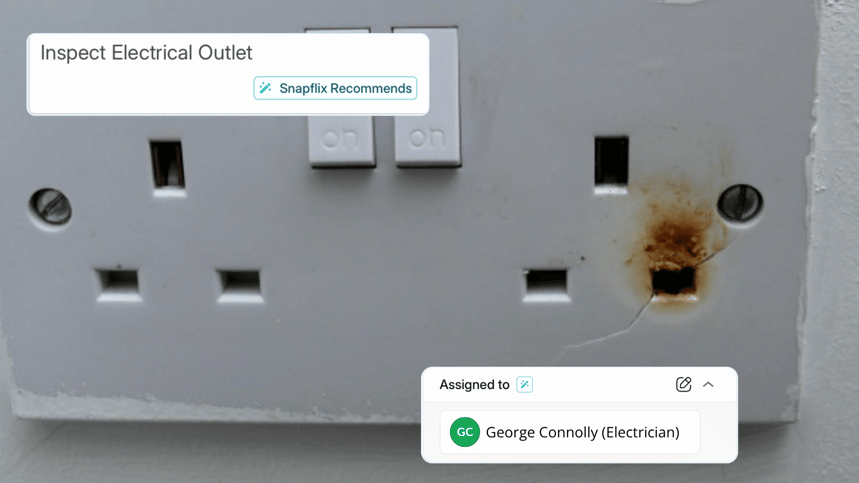
When a housekeeper spots a fault, the old process means describing it in writing, categorising it, assigning it, and hoping the message reaches the right person. For someone working in a second or third language, that is a real barrier.
With Snapfix's AI task creation, the housekeeper takes a photo. The AI reads the image, generates the task, assigns the right category, and routes it to the relevant engineer with the photo and room number attached. No form. No translation issue. No gap between spotting the problem and it landing in the right hands.
AI-Powered Housekeeping Scheduling That Updates Itself
The printed room board is accurate the moment it is printed and outdated shortly after. When a late checkout comes in or a VIP arrives early, the old model means manually relaying the change through a radio call, a group chat, or a search for the supervisor mid-shift.
Snapfix Housekeeping uses AI-driven scheduling that updates in real time. Priorities shift automatically. The team always has an accurate picture of what needs to happen first, without anyone having to chase the update.
Hotel Maintenance Checklists Built from Real Operational Data
Consistency is hard to maintain on any team. On a short-staffed one with newer employees still learning the property, it becomes fragile.
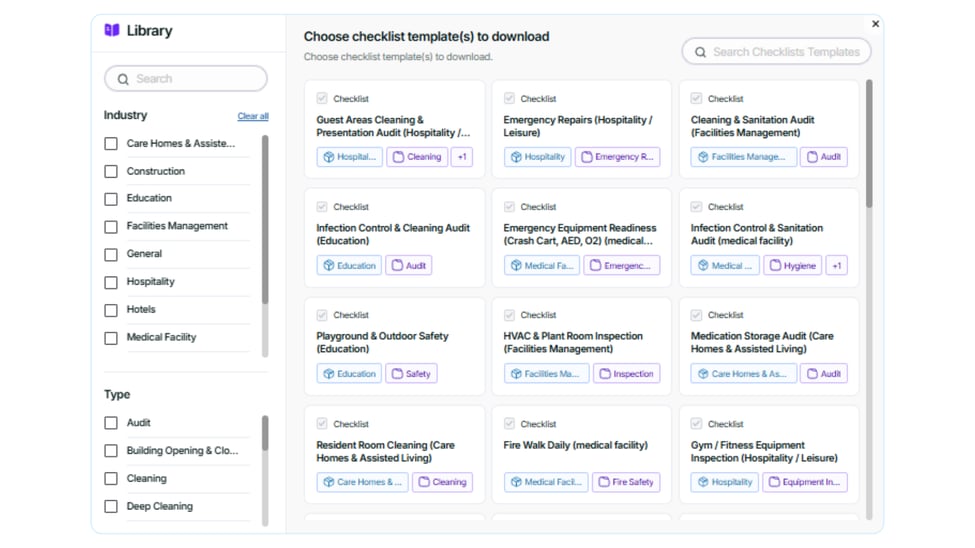
Snapfix's AI-generated checklists are built from data across thousands of real hotel operations, giving every team member a practical, proven standard from day one – regardless of experience level or how much time anyone had to train them.
Guest Messages That Become Tasks Automatically
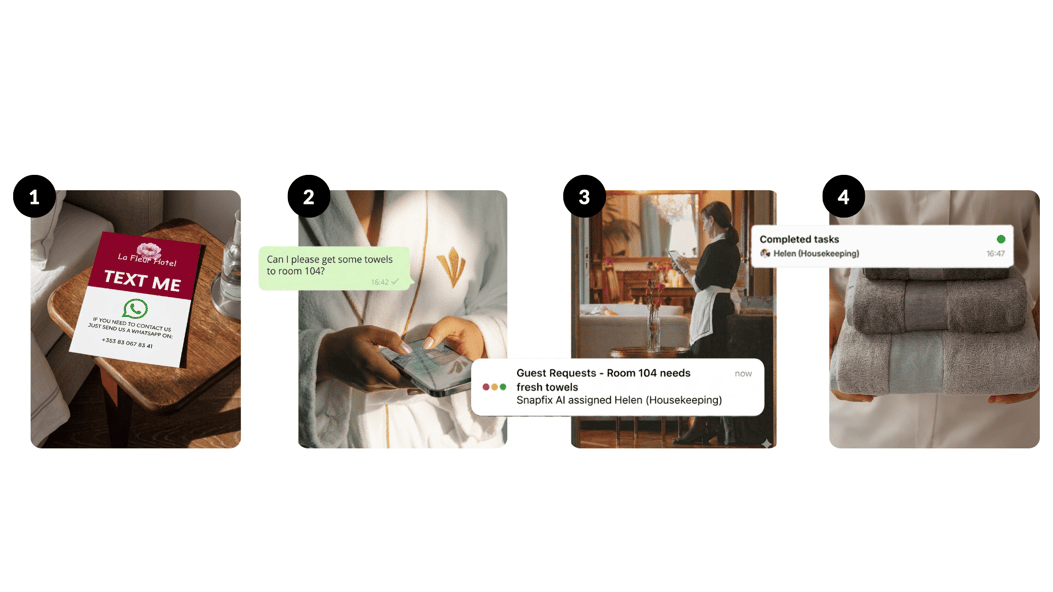
A guest messages asking for extra towels. Under the old process:
- • The message lands somewhere and waits to be noticed
- • Someone relays it to housekeeping
- • It gets logged and assigned
- • Someone follows up to confirm it was done
Every step is a gap. On a lean team, those gaps stretch. With Snapfix Guest Comms, the message becomes a task automatically. The right team sees it immediately. The front desk stays free for the guest standing right in front of them.
Proactive Hotel Maintenance: Catching Problems Before Guests Do
With IoT integrations, Snapfix receives signals from connected systems and creates tasks before the guest notices the issue. A WiFi drop, a temperature anomaly, a faulty sensor trigger – all converted into actionable tasks before anyone has a reason to complain.
A problem that would have generated a negative review gets resolved before checkout. For a short-staffed team, that proactive shift means maintenance effort goes where it matters most instead of into reactive scrambling.
Hotel Operations Results: The Numbers Speak for Themselves
AI is not about replacing the people hotels need. It is about removing the friction they are currently spending their working hours fighting through. Housekeepers still clean rooms. Engineers still fix things. Front desk teams still welcome guests. What changes is the overhead around those jobs.
Across Snapfix properties, that change is measurable:
- The Morrison Hotel saved 1.5 hours per day for their operational team
- The Brownwood Hotel & Spa in Florida recovered 12 hours per week on maintenance tasks
- Brocket Hall Estate cut maintenance administration time by 80%
The Bottom Line on Short-Staffed Hotel Teams
Short-staffed hotel teams are not doing less. They are operating in a mode where coordination consumes a disproportionate share of the capacity they do have. The maintenance, the housekeeping, the guest requests – all of it slows down not because people are not trying, but because the systems around them generate more overhead than a lean team can absorb.
Less chasing. More fixing. Less admin. More action. That is what Snapfix is built to deliver. And for the hotels still operating below full staffing strength, that difference is not theoretical. It shows up in every shift, every guest interaction, and every review.
Book a Demo or Start a Free Trial with Snapfix now.